
Your Venue Needs a Smart Glasses Policy
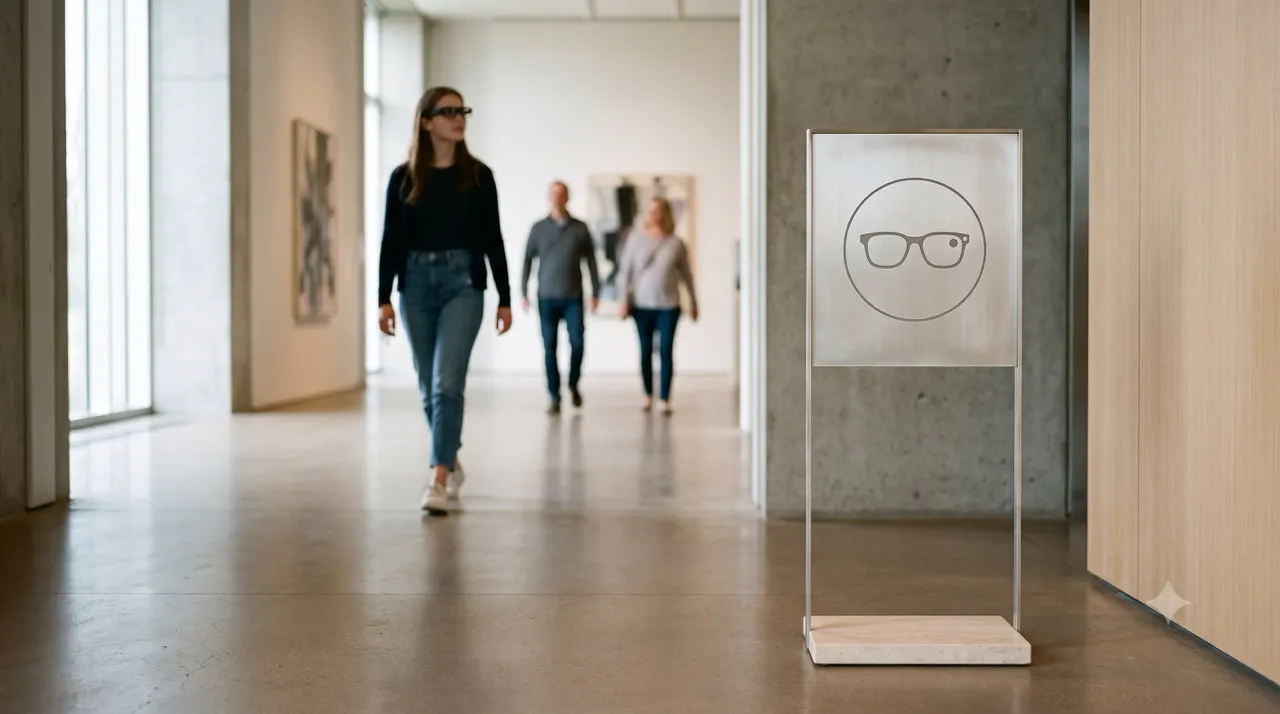
In Japan, every phone camera makes a shutter sound. You cannot turn it off, not in settings, not on silent, not with headphones in.
There is no law. The Japanese government doesn’t regulate the shutter sound; the industry regulates itself. The carriers and the manufacturers agreed it among themselves in the early 2000s, when camera phones arrived and people worked out very quickly what they could be used for.
It was a decision about consent, taken voluntarily, about twenty years before Japan got round to legislating on covert filming at all.
Smart glasses make no sound at all. And this month, venues stopped waiting. Let’s dive in.
One week in August
When I started this piece three weeks ago, my argument was that almost nobody running a physical space had a written position on people wearing cameras into it. That’s already out of date, and how fast it changed is the actual story.
In the second week of August, Wetherspoons put it in writing: their code already said no filming without consent, and they added that Meta glasses “breach this code, and common sense, by enabling surreptitious surveillance.” Soho House told members they’d be asked to remove them. ATG Theatres said the same across the West End. Jeremy King banned them from his dining rooms. DEF CON banned them in late July, Monopoly Events banned every recording device from its UK Comic-Cons, and ICE reminded its own agents that its body-camera ban covers them too.
Popular culture got there faster than the industry did. Jimmy Kimmel called them “pervert glasses” on national TV. Lorde told a crowd that smart glasses are “not sexy.”
Think about that. My whole argument here is that this is a consent problem, not a technology problem. It took popular culture four weeks to agree and give it a name. It took Japan’s phone industry twenty years.
So the question has changed. It’s not whether you need a position. It’s which one you’re about to write, because your sector is answering for you, and it’s answering with bans.
No policy? Ask CalMac.
In July, a Scottish ferry operator called CalMac paused public visits to the bridge of its ships. A passenger had filmed the crew and other passengers with Meta glasses, without telling anyone.
Read what they did carefully, because it matters more than the incident.
They did not ban the glasses. They closed the experience.
That’s what no policy looks like from the outside. Something happens, nobody has an answer ready, and the only move left is to cancel the thing. A bridge visit is a small, lovely piece of hospitality that costs almost nothing and that people remember. It’s gone now, because of one passenger and no rule.
The LED is going away
Here’s the trap, and most of this month’s policies walked straight into it.
The obvious rule is a hardware rule. No cameras. No visible recording light. We’ll ask you to take them off if we see them. Every version of that depends on your staff spotting the device, and that’s exactly what Meta is taking away.
On 7 July they pushed a mandatory firmware update that disables the camera if the capture light is tampered with. Tape over the LED and the glasses refuse to record. Good! Genuinely good. Within weeks there was a small cottage industry physically removing the LED instead.
Then the bigger one. On 9 July the Financial Times reported on Meta’s prototype “super sensing” glasses, aimed at late 2026 or early 2027. They’d capture audio continuously and photograph your surroundings every few seconds. There’s no plan to light the capture LED while that runs, and reportedly the executives don’t want it lit.
So Meta will defend the little light against a customer with a roll of tape, and quietly drop it from its own roadmap. Any policy resting on seeing a light has a shelf life of months. Write about behaviour, not hardware.
And the volume is still coming: Samsung’s glasses ship this autumn with Gentle Monster and Warby Parker, sold through eyewear shops rather than tech stores. Around 13.6 million units this year, roughly 27 million a year by 2030. They’ll arrive on the face of someone who bought nice frames and wasn’t thinking about you at all.
Who else is watching?
This is the part nobody is telling venue owners, and it’s the one that made me stop and reread.
In March, a class action was filed in San Francisco over the privacy claims made for Ray-Ban Meta glasses, sold with lines like “designed for privacy, controlled by you.” It followed a Swedish investigation that found workers at a Kenya-based subcontractor reviewing footage from customers’ glasses: nudity, people having sex, people using the toilet. Users can’t opt out, and the face-blurring Meta pointed to reportedly doesn’t work reliably.
Now put that in your building. Footage shot in your venue, by your guest, of your staff, reviewed by contractors on another continent. Not leaked, not hacked. The product working as designed.
That’s where “we had no rule” stops being an internal annoyance.
Three positions, and what each one costs
- Ban them. Clear, easy to explain, easy to put on a sign, and as of this month it’s what everyone else is doing. It works today because the glasses still look like glasses with something on them. In two years it stops working, because you’re asking a customer to remove their prescription eyewear at your door.
- It’s also not the safe option people assume. Refusing the glasses can trigger accommodation duties under the ADA, because for some people they’re assistive tech, not a gadget. Employment lawyers are already telling retailers to make the rule about conduct, not equipment. Same conclusion the technology pushes you to.
- Allow them. No friction, nothing to brief, nothing to enforce. And you own whatever happens. When someone films a member of your staff and it goes somewhere unpleasant, “we had no rule” is the whole of your defence.
- Allow them with a rule. No filming of staff or of other guests. Only in a dedicated area. Written into your house rules, and briefed to your team so they have a sentence ready. Not a legal document, one line and a bit of training.
Only the third one still works in three years.
The part that gets missed
This is about your staff more than your visitors.
Look at the second half of CalMac’s statement: “Our crews and port teams always welcome interest in CalMac, but their safety and wellbeing is our number one priority.”
That’s a company explaining, politely, that it closed a piece of hospitality it likes in order to protect its staff. Their problem wasn’t guest privacy in the abstract. It was crew being filmed at work, by a member of the public, while doing their job.
Monopoly Events got there too: they acted because talent and agents said being secretly recorded at signing tables was making them reconsider attending at all. That isn’t a customer experience problem, it’s a workforce problem.
Your hosts, your baristas, your gallery attendants, can’t give consent every time somebody walks in wearing a camera. They’re at work. If you’re going to write one line, write the one that protects them.
When banning is simply right
There’s a reversal here, and it’s not a small one.
Backstage. Kids’ areas. Changing rooms. Clienteling rooms where people are shown prices. Anywhere someone is paying or being trusted with something private. In those spaces a ban isn’t friction, it’s the basic duty of running the place, and nobody will argue with you.
Draw those lines now, on a floor plan, while it costs you nothing. Doing it calmly in August 2026 is free. Doing it during an incident is expensive and looks like panic.
What to actually write
Three lines is enough to start:
- Where glasses are fine.
- Where they are not, and why, in plain language.
- One sentence your staff can say out loud without it becoming a confrontation.
Twenty years ago the phone industry decided this for itself and gave every handset in Japan a sound it can’t switch off. The glasses industry hasn’t had that conversation, and the LED story suggests it won’t. What’s coming instead is regulation: the ACLU and seventy organisations in April, then Senators Markey, Wyden and Merkley, all asking Meta the same question about facial recognition. When an industry won’t have the consent conversation, someone else has it later, less carefully, and with no idea how a venue actually works.
Until then, the decision lands on whoever owns the room.
The venues that handle this well won’t be the ones with the strictest rule. They’ll be the ones whose staff already knew what to say.
Have you written anything down yet? Let’s discuss.
Related articles

Leveraging The XR Industry Split
Snap spins out its AR glasses as Specs Inc and Google partners with XREAL on Project Aura: how to navigate the 2026 XR rationalization.
The XR Split, 6 Months Later
XR shipments grew 44% in 2025 while VR headsets fell 14%. Why 'smart glasses' is really three products, and what the split means for brands.